Cat urine smell returns because dried urine leaves uric acid crystals that ordinary detergents cannot dissolve. To remove it permanently you have to find every affected spot (a UV light makes this far easier), saturate it with a bacterial-enzymatic cleaner to the full depth the urine reached, and let it dry slowly on its own. Never use ammonia, vinegar-only routines on old stains, or a steam cleaner — heat sets the odor permanently.
Key takeaways
- Cat urine contains uric acid crystals that are not water-soluble — this is why the smell comes back on humid days even after the area looks and smells clean.
- Enzymatic cleaners work by feeding bacteria that digest the crystals. They need contact time and moisture, so saturate generously and let the area air-dry rather than blotting it dry.
- Never apply heat. A steam cleaner bonds urine proteins to carpet fibers and makes the odor effectively permanent.
- Ammonia-based cleaners smell like urine to a cat and will actively encourage them to re-mark the same spot.
- If you are cleaning repeatedly, the cleaning is not the problem — find out why the cat is going outside the box.
Cat urine is the hardest household odor to remove, and the reason is chemical rather than a matter of effort. Most people clean the spot properly, the smell disappears for a week or two, and then on the first humid day it is back exactly as strong as before. That is not a failure of scrubbing. It is a sign that the cleaner used never touched the compound actually causing the smell.
This guide covers the full method: how to find every affected area, what cleaner chemistry genuinely works, and how to handle each surface type — carpet, hardwood, upholstery, concrete, and clothing.
Why Cat Urine Smell Is So Persistent
Fresh cat urine is mostly water, urea, creatinine, electrolytes, and uric acid. In the first hours, bacteria break down the urea and release ammonia — that is the sharp, eye-watering top note.
As it dries, something less convenient happens. The uric acid forms crystalline salts that are not water-soluble. Soap will not lift them. Detergent will not lift them. They bond into carpet fibers, grout, wood grain and concrete pores and simply stay there.
Those crystals are also hygroscopic: they pull moisture out of the air. Every time humidity climbs, they rehydrate and start releasing odor again. This is exactly why the smell seems to return from nowhere, and why a room can smell fine in winter and unbearable in July.
Cat urine also contains felinine, a sulphur-containing amino acid that breaks down into thiols — the same family of compounds responsible for skunk spray. Male cats, particularly unneutered ones, produce more of it, which is why their urine smells markedly worse. Our guide to the science of cat odor covers this chemistry in more detail.
Why ordinary cleaners fail
Detergents dissolve fats and lift dirt. They do nothing to a crystalline salt. To remove uric acid you need either an enzymatic product that biologically digests it, or a strong oxidizer — and oxidizers will damage most soft furnishings.
Step 1: Find Every Spot Before You Clean Anything
Cleaning what you can see and stopping there is the most common mistake. If a cat has been going outside the box for weeks, there is almost always more than one site, and the ones you have not found will keep the room smelling.
Use a UV blacklight in a fully dark room. Dried urine fluoresces a dull yellow-green. Turn off every light, close the curtains, and sweep the beam slowly across:
- Carpet edges and the perimeter of the room
- The base of walls and skirting boards (male cats spray upward, so check 10–20 cm up the wall)
- Under and behind furniture, especially sofas and beds
- Curtain hems
- Rugs, on both sides
- Laundry piles and bath mats
Mark each spot with painter's tape or a small sticky note as you find it. It is genuinely common to find six or eight spots when you expected one.
Trust your nose at floor level too. Get down and smell directly. Odor rises and disperses, so standing height tells you very little about where the source actually is.
Vertical marks mean something different
Urine found on a vertical surface — a wall, a chair leg, the side of a cabinet — at roughly your cat's standing height is spraying, not a litter box failure. It is territorial communication and needs a different response. See our guide on cat spraying vs. peeing to work out which one you are dealing with, because the fix is completely different.
Step 2: Choose a Cleaner That Actually Works
Bacterial-enzymatic cleaners — the correct tool
These contain live bacterial cultures plus enzymes. The bacteria consume the uric acid and organic residue and convert them to carbon dioxide and water. Nothing is masked; the source is metabolically removed.
Two things matter enormously and are almost always done wrong:
- Volume. You must apply enough to reach the full depth the urine reached. Urine spreads outward as it soaks, so treat an area noticeably wider than the visible stain — roughly one and a half times the diameter.
- Contact time. Bacteria need to stay wet to work. A spray-and-wipe gives them seconds. They need at least 10–15 minutes, and ideally hours on an old spot.
Rocco & Roxie Professional Strength and Nature's Miracle Advanced Platinum are the two most widely used bacterial-enzymatic formulas for exactly this job. Our full breakdown of enzyme cleaners for cat urine explains how the different formulations compare, and our wider guide to the best enzyme cleaners for pet stains covers what to look for on the label.
What to avoid, and why
| Product | Why it fails |
|---|---|
| Ammonia-based cleaners | Ammonia is a breakdown product of urine. To a cat, the treated spot now smells like a toilet — you are inviting a repeat. |
| Bleach | Does not dissolve uric acid, damages many surfaces, and produces hazardous chloramine gas if it contacts urine ammonia. |
| Vinegar alone | Neutralizes ammonia only. On dried urine the crystals remain and the odor returns. |
| Steam cleaners / hot extraction | Heat denatures and bonds urine proteins to fibers. This is the one mistake that can be genuinely permanent. |
| Scented sprays and plug-ins | Mask nothing at the source. The odor simply layers with the fragrance. |
Never mix cleaners
Do not combine bleach with ammonia, and do not apply bleach over an area that still holds urine. The reaction releases chloramine gas, which is toxic in an enclosed room.
Step 3: The Method, Surface by Surface
Carpet and rugs
- Blot, do not rub, if the accident is fresh. Press with paper towel or an old towel and stand on it. Rubbing spreads urine deeper into the pile and the pad.
- Optional cold-water rinse. Pour a small amount of cold water and blot again to dilute what is still liquid. Skip this on dried spots.
- Saturate with enzymatic cleaner. Genuinely saturate — you want it to reach the pad if the urine did. Extend past the stain edge.
- Keep it wet. Lay a damp towel over the area, or plastic sheeting weighted at the edges, for several hours.
- Let it air-dry completely. No hairdryer, no heater. This can take 24–48 hours.
- Reassess with the UV light once fully dry. Old, deep spots often need a second full treatment. This is normal, not a sign the product failed.
If the pad underneath is saturated, surface treatment will not be enough. Cutting out and replacing that section of pad, then sealing the subfloor beneath with a shellac-based primer, is the reliable fix.
Our dedicated guide on getting cat litter smell out of carpet covers the tracked-litter and dust side of the problem, which is a different issue from urine and worth treating separately.
Hardwood and laminate
Wood is difficult because urine wicks along the grain and into the seams between boards.
- Clean the surface first with an enzymatic cleaner, working along the grain.
- Treat the seams specifically — apply cleaner into the joint and let it wick down.
- If the smell persists, the urine has reached the wood beneath the finish. Sanding that section and sealing with a shellac-based primer before refinishing is the only complete solution.
- On laminate, urine that has reached the core through a seam usually means that plank has to be replaced; the core swells and holds odor indefinitely.
Never let liquid pool on wood. Apply, work in, and blot the excess rather than flooding it.
Upholstery and mattresses
- Test the cleaner on a hidden section first.
- Apply enough to match the depth of the original soak — foam absorbs a lot.
- Press gently with a towel to move the cleaner through the foam rather than only across the fabric.
- Dry with a fan and good airflow, not heat.
- Mattresses often need two or three treatments. A waterproof protector afterwards is worth it, since a mattress cannot be replaced cheaply.
Concrete, tile and grout
Concrete is porous and will hold urine for years.
- Grout lines are usually the real problem on tile. Apply cleaner directly along them and let it sit.
- On bare concrete in a garage or basement, saturate heavily and repeat. After it is fully clean and dry, sealing the concrete prevents any future accident from soaking in.
Clothing, bedding and towels
- Rinse in cold water first. Hot water sets the stain.
- Add an enzymatic cleaner or an enzyme-based laundry detergent and let the item soak for at least an hour.
- Wash on a cold cycle with a half cup of baking soda alongside the detergent.
- Air-dry and check before machine drying. A dryer's heat will set any remaining odor permanently.
Step 4: Stop It Happening Again
If you are cleaning the same spot repeatedly, cleaning is no longer the problem. A cat urinating outside the box is communicating something specific.
Rule out medical causes first. Urinary tract infections, feline lower urinary tract disease, kidney disease, diabetes and arthritis all cause litter box avoidance, and some are urgent. A male cat straining without producing urine is an emergency. Our guide on why cats suddenly pee outside the litter box walks through the medical and behavioral causes in order.
Then audit the box setup:
- One box per cat, plus one spare. Two cats means three boxes.
- Scoop at least twice a day. See how often to clean a litter box for a realistic schedule.
- Try an uncovered box — some cats feel trapped in hooded ones. Our covered vs. uncovered comparison covers the trade-offs.
- Move the box somewhere quieter and less trafficked.
- Switch to an unscented, fine-grained clumping litter. Most cats prefer it, and our odor-control litter guide explains which types manage smell best without added fragrance.
Consider stress. Feline idiopathic cystitis causes genuine urinary symptoms with no infection present, and it is driven by stress. A new pet, building work, a schedule change or a new person in the house can all trigger it. Our guide to the signs a cat is stressed covers what to look for.
Make the old spot unattractive. Once an area is genuinely clean, place a food bowl, a toy or a scratching post there temporarily. Cats rarely eliminate where they eat or play.
When to call your vet
Book an appointment promptly if your cat is straining, crying in the box, urinating far more or far less than usual, passing blood, or has stopped eating. A blocked urethra — most common in male cats — can be fatal within 24 to 48 hours. If your cat is straining and producing nothing, treat it as an emergency and go now. Blood in the litter box always warrants a same-day call.
A Realistic Cleaning Checklist
- Dark room, UV light, every spot marked
- All ammonia, bleach and scented products set aside
- Bacterial-enzymatic cleaner on hand, in a large enough bottle
- Fresh spots blotted, never rubbed
- Treated area extended well past the visible stain
- Area kept wet for the full contact time
- Air-dried completely — no heat, no steam, no hairdryer
- Re-checked with UV once dry, second treatment applied where needed
- Litter box count, cleaning frequency and location reviewed
- Vet appointment booked if this is new behavior
The Bottom Line
Cat urine smell is not a cleaning-effort problem, it is a chemistry problem. Uric acid crystals do not dissolve in water or detergent, so anything that does not biologically break them down is only ever buying you a few weeks. Find every spot with a UV light, saturate properly with a bacterial-enzymatic cleaner, give it real contact time, and let it dry on its own.
And if you find yourself doing this repeatedly, treat that as information rather than a chore. A cat that keeps urinating outside the box is telling you something is wrong — medically, environmentally, or emotionally — and that is the part worth solving.
Frequently asked questions
Why does cat urine smell come back when it rains or gets humid?
Uric acid crystals left behind in the fibers or subfloor are hygroscopic — they draw in moisture from the air. When humidity rises, the crystals rehydrate and release odor compounds again. This is the clearest sign that a previous cleaning removed the visible stain but not the crystals, and that the area needs a full enzymatic treatment.
Does vinegar remove cat urine smell?
Vinegar neutralizes the ammonia component and can help on a fresh accident caught within minutes, but it does not dissolve uric acid crystals. On a dried or repeat spot, vinegar alone will reduce the smell temporarily and it will return. Use vinegar as an optional first rinse if you like, then follow with an enzymatic cleaner.
Can I use a steam cleaner or carpet shampooer on cat urine?
Not with heat. Steam sets the proteins in urine into carpet fibers and makes the odor extremely difficult to remove afterwards. If you use a machine, use cold water only, and never run a heated machine over an area you have not already treated enzymatically.
How long does an enzyme cleaner need to work?
Most need a minimum of 10 to 15 minutes wet contact, and heavily soiled areas benefit from staying damp for several hours. Cover the treated area with a damp towel or plastic sheet to slow evaporation. Rushing the drying is the single most common reason enzymatic cleaning fails.
What if the urine soaked through to the padding or subfloor?
Then surface cleaning cannot reach it. You need to apply enough cleaner to penetrate to the same depth the urine reached, which usually means far more liquid than feels reasonable. For badly saturated carpet, replacing the pad in that section and sealing the subfloor with a shellac-based primer is often the only permanent fix.
Products recommended in this guide
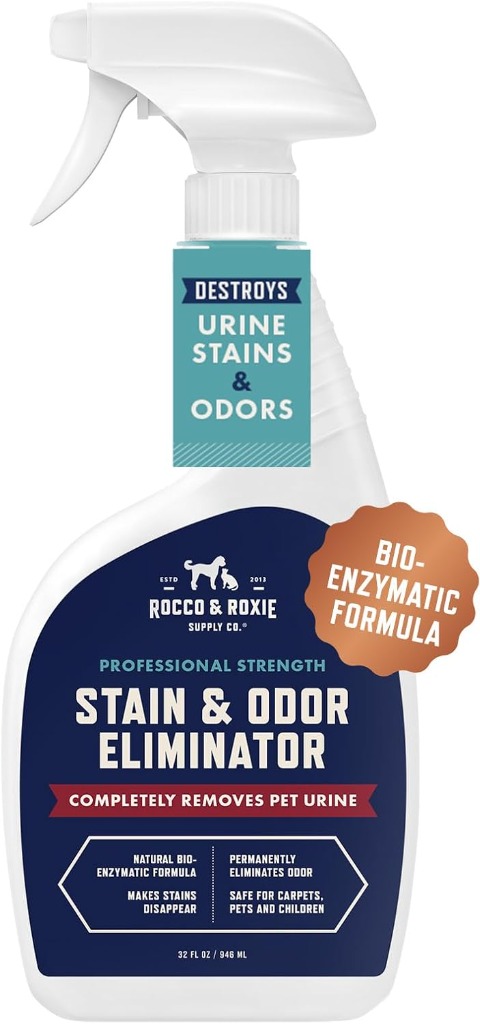
Rocco & Roxie Professional Strength Stain & Odor Eliminator
Best for: Deep enzyme cleaning of cat odors embedded in carpet
- Bacterial-enzymatic formula targets uric acid rather than masking it
- Safe on carpet, upholstery and sealed hard floors
- Large bottle size suits the generous saturation the method requires
- Needs long contact time — this is not a wipe-and-go product
Nature's Miracle Advanced Platinum Formula
Best for: Eliminating cat urine and fecal odors from any surface
- Formulated for set-in and repeat-offender stains
- Widely available and well established
- Works on both urine and fecal odor
- Scent of the product itself is noticeable while drying
As an Amazon Associate, PetMessFix earns from qualifying purchases. You pay the same price — we earn a small commission at no extra cost to you.