If you've ever scrubbed a cat urine stain thoroughly, thought the smell was gone, and then noticed it returning — especially in humid weather — you've encountered the core problem with conventional cleaning products: they don't actually eliminate cat urine odor. They mask it temporarily, but the chemistry driving the smell is left intact.
Enzyme cleaners work differently. This guide explains the science behind why they're uniquely effective, how to use them correctly, and why the application method matters as much as the product itself.
Why Regular Cleaners Fail Against Cat Urine
Cat urine is chemically more complex than it appears. It contains:
- Urea — a compound that bacteria break down into ammonia over time
- Uric acid — forms crystals that are water-insoluble and reactivate when humidity returns
- Creatinine — contributes to odor as it degrades
- Pheromones — marking compounds that persist and signal to the cat to return to the same spot
- Ammonia — a direct byproduct of bacterial breakdown of urea
Standard cleaners — soap, vinegar, hydrogen peroxide, commercial floor cleaners — can address the water-soluble components (urea, creatinine, some bacteria) but cannot dissolve uric acid crystals. These crystals bond to surfaces, remain inert when dry, and reactivate every time humidity rises. This is why a room that smelled clean for a week can suddenly smell strongly of urine during humid weather.
For the full chemistry, see our guide to the science of cat odor.
How Enzyme Cleaners Work
Enzyme cleaners work through a two-step biological process:
Step 1: Bacterial Application
The cleaner contains live bacterial cultures — typically species of Bacillus — that are introduced to the soiled area in a dormant state. Contact with moisture activates them.
Step 2: Enzyme Production and Breakdown
The active bacteria produce specialized enzymes targeted at the specific molecular bonds in cat urine compounds:
- Urease breaks urea into carbon dioxide and water
- Protease breaks down protein-based compounds (creatinine, pheromone proteins)
- Lipase addresses fatty compounds in the waste
- Amylase targets carbohydrate-based residue
The end products are carbon dioxide, water, and simple harmless salts — genuinely odorless, not just masked.
This is fundamentally different from products that neutralize surface odors or introduce competing fragrances. Enzyme cleaners eliminate the source compounds rather than covering them.
How to Use Enzyme Cleaners Correctly
Correct application is critical. The most common reason enzyme cleaners appear not to work is improper use.
1. Remove Solids and Blot Fresh Liquid First
For a fresh accident, blot up as much urine as possible with paper towels — do not rub. Press firmly and repeat with fresh towels until you've absorbed as much as possible. For dried or old stains, skip directly to the enzyme application.
2. Saturate, Don't Spray Lightly
The enzyme cleaner must penetrate to the same depth as the urine. For carpet, this means soaking through to the padding. For fabric, soaking through the layers. A light surface spray will only treat the top layer while odor sources in deeper layers remain.
Nature's Miracle Advanced Platinum Formula uses a pro-bacteria formulation that continues working after initial application as it penetrates deep into porous surfaces — making it particularly effective for set-in odors on carpet and upholstery.
3. Allow Adequate Dwell Time
Allow the cleaner to sit for at least 10–30 minutes. For severe or set-in odors, covering the area with a damp cloth (to keep it moist) and leaving it for several hours is more effective. The bacteria need time and moisture to complete their work.
4. Blot and Air Dry
After the dwell period, blot up excess liquid and allow the area to air dry naturally. Do not use heat to speed drying — elevated temperatures kill the live bacteria before they finish working. A fan aimed at the area speeds evaporation without heat.
5. Repeat for Old Stains
Odors that have been present for months or years may require two or three treatment cycles to fully resolve. Let each treatment dry completely before reassessing.
Common Mistakes That Undermine Enzyme Cleaners
- Using too little product — the most common mistake; always saturate fully
- Not allowing enough dwell time — blotting immediately negates the process
- Using hot water to dilute — heat kills live bacteria
- Mixing with bleach or disinfectants — deactivates the bacterial cultures
- Applying over other chemical cleaners — residual cleaning agents can inhibit bacterial activity; rinse with plain water first if the area was previously treated
What Surfaces Work Best (and Worst)
Enzyme cleaners work well on: - Carpet (most common application) - Upholstery and fabric - Sealed tile and grout - Sealed concrete - Most mattress materials
Use with care on: - Unsealed hardwood (moisture can cause warping) - Natural stone (test first; some formulas affect stone sealants) - Silk or delicate fabrics
For carpet specifically, see our detailed step-by-step guide on getting cat litter smell out of carpet.
Why Pheromones Matter
One underappreciated function of enzyme cleaners is the breakdown of feline marking pheromones. These compounds signal to the cat that this is an appropriate elimination spot and trigger a return visit. Standard cleaners leave these intact. Enzyme cleaners break them down, removing the chemical signal and significantly reducing the likelihood of repeat incidents in the same location.
If your cat has been returning to the same inappropriate spot, incomplete pheromone removal is often a key factor alongside the more obvious odor. This is directly relevant to the broader issue of cats peeing outside the litter box and can accelerate retraining.
The Bottom Line
Enzyme cleaners are not a premium option — they're the only option that actually works on cat urine at the molecular level. The active biological process they contain is the only mechanism capable of breaking down uric acid crystals and pheromone compounds. Used correctly — with full saturation, adequate dwell time, and air drying — they resolve even severely set-in cat odor. Use them on every urine accident, every time, and the results are consistent.
Frequently asked questions
Do enzyme cleaners actually work on cat urine?
Yes — enzyme cleaners are the most effective solution for cat urine odor because they work at the molecular level. The live bacteria in enzyme cleaners produce enzymes (urease, protease) that break apart uric acid crystals and ammonia compounds into odorless byproducts. Standard cleaners cannot do this and simply mask odor temporarily.
How long does it take for an enzyme cleaner to work on cat urine?
Most enzyme cleaners require a minimum dwell time of 10–30 minutes for surface-level odors, and several hours for deep or set-in odors. The bacterial enzyme process continues as long as the area remains moist, which is why adequate saturation and allowing the area to air-dry slowly (rather than blotting immediately) maximizes effectiveness.
Can enzyme cleaners be used on all surfaces?
Most enzyme cleaners are safe for carpet, upholstery, tile, sealed hardwood, and most fabrics — but always check the product label and test on a small, inconspicuous area first. Avoid using on unsealed wood, silk, or wool without testing. Do not mix with bleach or other disinfectants, as this deactivates the live bacteria.
Products recommended in this guide
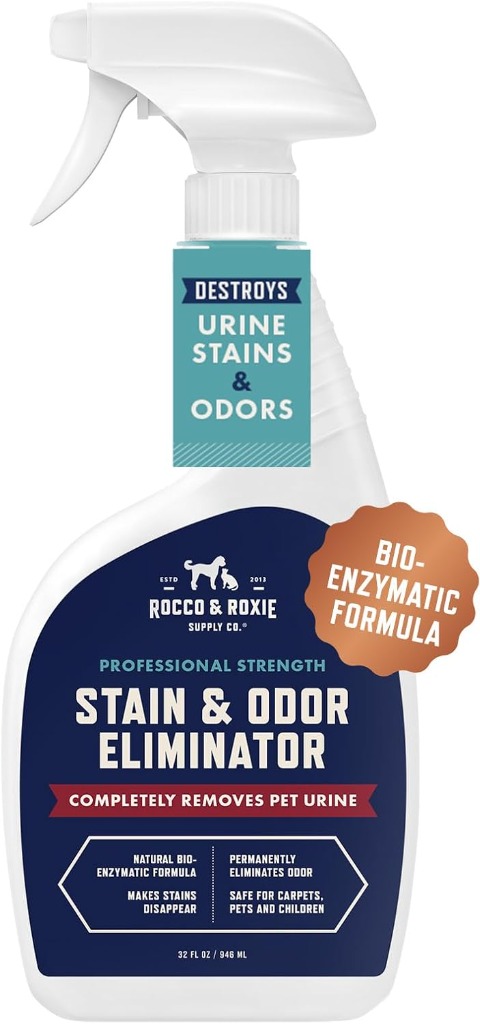
Nature's Miracle Advanced Platinum Formula
Best for: Eliminating cat urine and fecal odors from any surface
- Enzyme-activated bacterial formula breaks down uric acid
- Works on multiple surfaces including carpet, hardwood, tile
- Pro-bacteria technology continues working after application
- Strong initial odor during application that fades as it works
As an Amazon Associate, PetMessFix earns from qualifying purchases. You pay the same price — we earn a small commission at no extra cost to you.