
Look for a bacterial-enzymatic cleaner — one containing live bacterial cultures, not just enzymes — sold in a large enough bottle to saturate properly, and free of added fragrance, ammonia and oxidisers. The mechanism matters more than the brand: bacteria digest the uric acid crystals that ordinary detergents leave behind. Whatever you buy will fail if you under-apply it or let it dry too quickly, because contact time is what does the work.
Key takeaways
- Pet urine odor comes from uric acid crystals, which are not water-soluble. Only biological digestion or aggressive oxidation removes them.
- Buy a product with live bacterial cultures, not one that only lists enzymes — the bacteria are what keep working after the enzymes are spent.
- Bottle size is a genuine specification. Correct use means saturating the full depth of the spill, which uses far more liquid than people expect.
- Avoid added fragrance, ammonia, bleach and oxidisers on pet urine — fragrance masks, ammonia attracts re-marking, and oxidisers damage fabrics.
- Contact time and slow drying matter more than which brand you buy. Most failures are application failures.
Almost every failed pet-stain cleanup fails for the same reason, and it is not effort. It is that the product used had no mechanism for removing the compound actually causing the smell.
This guide covers what enzymatic cleaners do, which specifications on the bottle genuinely matter, and how to match a product to the type of mess you are dealing with.
Why Ordinary Cleaners Cannot Work
Pet urine is mostly water, urea, creatinine, electrolytes and uric acid. The first few components rinse away easily. Uric acid does not.
As urine dries, uric acid forms crystalline salts that are not water-soluble. Detergent cannot dissolve them. Scrubbing does not lift them. They bond into carpet fibres, grout, wood grain and concrete pores and stay there.
Worse, those crystals are hygroscopic — they draw moisture from the air. Every humid day rehydrates them and releases odor again. That is precisely why a spot you cleaned thoroughly in February smells again in July.
The mechanism that matters
An enzymatic cleaner is not a stronger detergent. It is a biological product: live bacteria consume the uric acid and organic residue and convert them into carbon dioxide and water. Nothing is masked, and nothing is left to rehydrate.
Our science of cat odor explainer covers the chemistry in more depth, including why male cat urine is so much worse than female.
What to Look For on the Label
1. Bacterial cultures, not just enzymes
This is the most useful distinction and the least advertised.
Enzyme-only products contain proteins that catalyse the breakdown of specific molecules. They work, but enzymes are consumed as they react and stop once they are spent.
Bacterial-enzymatic products contain live bacterial cultures that produce enzymes continuously as they feed. They keep working for as long as the area stays moist and there is residue left to consume.
For pet urine, you want the second kind. Look for "live bacterial cultures", "bio-enzymatic", "bacteria-based" or a named strain count on the label. A product that only says "with enzymes" is usually the weaker option.
2. Bottle size
An unglamorous specification that turns out to matter a great deal.
Correct application means saturating to the full depth the urine reached, over an area wider than the visible stain. On carpet with padding underneath, a single accident can require half a litre or more. A 250 ml trigger spray does not allow that, and people compensate by under-applying — which is the same as not treating it at all.
Buy the largest size available for anything beyond a small surface spot.
3. No added fragrance
Fragrance is there for the buyer, not for the job. It masks odor rather than reducing it, and if you are cleaning up after a cat, strong scent can actively discourage them from returning to a litter box nearby. Our odor-control litter guide covers why unscented is almost always the right call around cats.
4. No ammonia, bleach or oxidisers
- Ammonia is a breakdown product of urine. Cleaning with it effectively re-marks the spot on your pet's behalf.
- Bleach does not dissolve uric acid, damages many surfaces, and produces chloramine gas when it meets urine ammonia.
- Hydrogen peroxide and other oxidisers can break odor compounds but frequently bleach carpet and upholstery. Some products combine peroxide with enzymes; the peroxide can also kill the bacteria you are relying on.
5. Surface compatibility
Check the label for the surfaces you actually have — carpet, upholstery, sealed hardwood, tile and grout, mattresses, concrete. Always patch-test somewhere hidden first, particularly on wool and silk.
6. Pet and child safety
Look for products stating they are safe for use around pets and children once dry. Keep everyone off the area until it has dried completely.
Matching the Product to the Mess
Cat urine — the hardest case
Cat urine has the highest uric acid concentration and additionally contains felinine, which breaks down into sulphur compounds in the same chemical family as skunk spray.
What you need: a bacterial-enzymatic cleaner in a large bottle, applied generously with a long contact time.
Rocco & Roxie Professional Strength and Nature's Miracle Advanced Platinum are the two most established options for this specific job. Our detailed comparison of enzyme cleaners for cat urine covers how the formulations differ, and our full cat urine smell removal guide covers the method surface by surface.
If you are cleaning cat urine repeatedly, treat that as information rather than a chore. Our guides on cats peeing outside the litter box and spraying vs. peeing cover why it happens and what stops it.
Dog urine
Chemically similar to cat urine but usually lower in uric acid concentration and higher in volume — which means it penetrates further and faster.
What you need: the same bacterial-enzymatic chemistry, but expect to use more of it. Deal with it quickly; volume plus gravity means dog urine reaches carpet padding sooner.
Our guide on cleaning dog urine from carpet covers the technique, including how to handle a spot that has already reached the pad.
Feces
The odor here comes from sulphur compounds and volatile fatty acids rather than uric acid.
What you need: an enzymatic cleaner with protease and lipase activity. Most general pet formulas cover this. Remove as much solid material as possible first — cleaner applied over residue simply dilutes itself.
Vomit
Contains stomach acid, which can damage carpet dye and fibres if left. Blot thoroughly first, then treat enzymatically for the protein and fat residue. Acting quickly matters more here than with urine.
If vomiting is recurrent, that is worth addressing rather than just cleaning up — our guide on vomiting in dogs covers when it warrants a vet call.
Embedded hair
Not an odor problem, but worth pairing with one. Hair woven into upholstery holds dander and skin oils and contributes to a general animal smell that no cleaner will fix while the hair is still there.
A mechanical remover such as the ChomChom uses friction rather than adhesive, so there is nothing to refill. It is a complement to enzymatic cleaning, not a substitute — our ChomChom review covers what it does and does not do.
How to Actually Use It
Product choice is roughly a third of the outcome. Application is the rest.
1. Blot first, never rub. Press with towels and stand on them. Rubbing drives liquid deeper into the pile and spreads it.
2. Skip the pre-cleaner. Do not use detergent or a spot cleaner before applying an enzymatic product. Surfactant residue interferes with bacterial activity.
3. Saturate generously. Match the depth the urine reached, and extend roughly one and a half times past the visible stain, because urine spreads outward as it soaks.
4. Keep it wet. Cover with a damp towel or plastic sheeting weighted at the edges. Bacteria need moisture to work — this is the step that separates success from failure.
5. Give it time. Ten to fifteen minutes minimum. Several hours for set-in stains. Overnight for anything that has been there for months.
6. Air-dry completely. No hairdryer, no heater, no steam cleaner. Heat permanently bonds urine proteins to fibres and is the one mistake that can be genuinely irreversible.
7. Check with a UV light once dry. Dried urine fluoresces in the dark. If it still glows, treat again. Second and third applications on old stains are routine.
The three things that ruin a cleanup
Using a steam cleaner or any heat. Using an ammonia-based product. Applying too little cleaner and letting it dry within minutes. Any one of these will make the odor worse or permanent.
What Does Not Work
| Approach | Why it fails |
|---|---|
| Vinegar alone | Neutralises ammonia only; leaves uric acid crystals intact |
| Baking soda alone | Absorbs surface moisture; does nothing at depth |
| Carpet shampoo | Detergent chemistry, no effect on uric acid |
| Steam cleaning | Heat sets proteins into fibres permanently |
| Scented sprays and plug-ins | Layer fragrance over odor; source untouched |
| Homemade "enzyme" recipes | No bacterial cultures specific to urine; temporary at best |
| Ammonia-based cleaners | Smell like urine to pets; invite re-marking |
When the Cleaner Is Not Enough
Sometimes the problem is beyond a surface product.
Urine that has reached the carpet pad. Surface treatment cannot reach it. Cutting out and replacing that section of pad, then sealing the subfloor with a shellac-based primer, is the reliable fix.
Urine soaked into unsealed hardwood. Once past the finish, the wood itself holds it. Sanding and sealing that section is usually the only complete answer.
A litter box area that smells regardless. The pan itself may be the source — scratched plastic holds urine indefinitely. Replace pans annually. Our guides on litter boxes that smell after cleaning and how often to clean a litter box cover the rest.
Repeat accidents in the same place. Cleaning will never resolve a behavioral or medical cause. Our guide on getting cat litter smell out of carpet covers the tracked-litter side, and our Rocco & Roxie review goes into detail on the product most often recommended for the urine side.
A Practical Buying Checklist
- Live bacterial cultures listed, not enzymes alone
- Largest bottle size available for the area you need to treat
- No added fragrance
- No ammonia, bleach or peroxide in the ingredients
- Rated for your specific surfaces
- Stated as safe around pets and children once dry
- Within its shelf life — bacterial cultures are living and do degrade
Store it properly
Bacterial cleaners contain live organisms. Keep the bottle out of direct sunlight, avoid freezing and avoid high heat, and check the expiry date. An old bottle stored in a hot garage may have very little activity left, which is an under-appreciated reason a previously reliable product suddenly seems ineffective.
The Bottom Line
The specification that matters is the mechanism: live bacterial cultures that digest uric acid, in a bottle large enough to let you apply the amount the job actually needs, without fragrance or oxidisers working against it.
After that, technique decides the outcome. Saturate properly, keep it wet, give it hours rather than minutes, and never apply heat. Most people who conclude that enzyme cleaners do not work have used a small bottle of the right product in the wrong way — and the fix costs nothing but patience.
Side-by-side comparison
Selected by Sarah Jenkins, Certified Veterinary Technician (CVT)
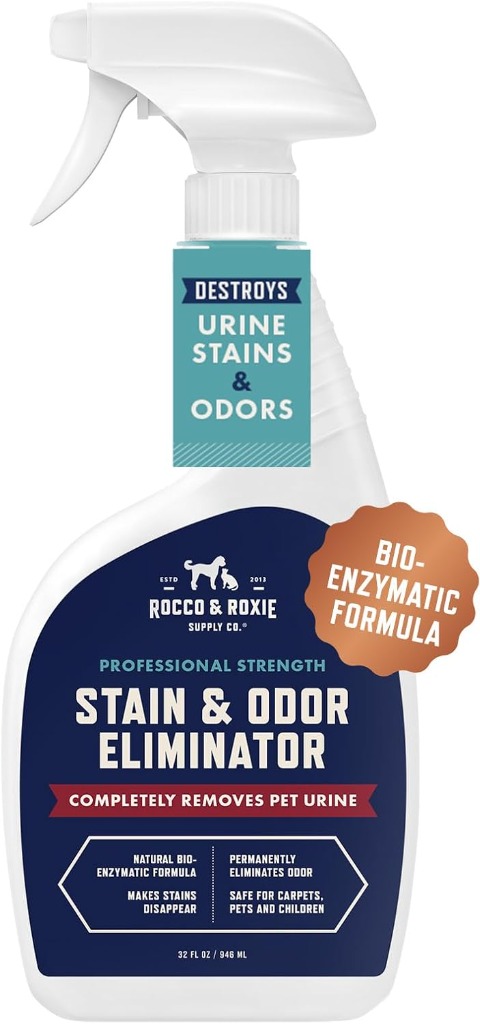 Rocco & Roxie Professional Strength Stain & Odor Eliminator
Nature's Miracle Advanced Platinum Formula
Rocco & Roxie Professional Strength Stain & Odor Eliminator
Nature's Miracle Advanced Platinum Formula
As an Amazon Associate, PetMessFix earns from qualifying purchases. You pay the same price — we earn a small commission at no extra cost to you.
Frequently asked questions
What is the difference between an enzyme cleaner and a regular cleaner?
Regular detergents lift oils and dirt so they can be rinsed away. They have no effect on uric acid crystals, which is the compound responsible for lingering pet urine odor. Enzymatic cleaners contain bacteria and enzymes that biologically break those compounds down into carbon dioxide and water, removing the source rather than covering it.
How long do you leave an enzyme cleaner on?
A minimum of ten to fifteen minutes of wet contact, and considerably longer for set-in stains — ideally several hours. The bacteria need moisture to stay active, so cover the treated area with a damp towel or plastic sheeting to slow evaporation. Letting it dry too fast is the single most common reason enzymatic cleaning appears not to work.
Do enzyme cleaners work on old, dried stains?
Yes, but they need more product, more contact time, and often more than one application. An old stain has had time for urine to penetrate deep into carpet padding, wood grain or grout, and the cleaner has to reach the same depth the urine did. Treating an old stain two or three times is normal rather than a sign of failure.
Can I make my own enzyme cleaner at home?
Not effectively. Recipes based on vinegar, baking soda and hydrogen peroxide can reduce surface odor temporarily, but none of them contain the bacterial cultures that digest uric acid, so the smell returns once humidity rises. Fermented citrus-peel recipes produce a mild cleaner but do not reliably contain the specific organisms needed for urine.
Are enzyme cleaners safe for pets and children?
Generally yes when used as directed — the active components are bacteria and enzymes rather than harsh chemistry. Keep pets and children off the treated area until it is fully dry, ventilate the room, and check the label of any product that also contains surfactants or preservatives. As with any cleaner, store it out of reach.
Products recommended in this guide
Rocco & Roxie Professional Strength Stain & Odor Eliminator
Best for: Deep enzyme cleaning of cat odors embedded in carpet
- Bacterial-enzymatic formula that targets uric acid rather than masking it
- Available in large bottles, which suits the saturation the method needs
- Works on carpet, upholstery and sealed hard floors
- Requires long contact time — not a wipe-and-go product
Nature's Miracle Advanced Platinum Formula
Best for: Eliminating cat urine and fecal odors from any surface
- Formulated for set-in and repeat-offender stains
- Handles fecal and vomit odor as well as urine
- Very widely available
- The product's own scent is noticeable while drying

Hepper Advanced Bio-Enzyme Pet Stain and Odor Eliminator
Best for: Removing Tempting Scents
- Targets the residual scent markers that invite repeat soiling
- Good on bedding and soft furnishings
- Lighter scent profile than most competitors
- Smaller bottle sizes make large-area treatment expensive
ChomChom Pet Hair Remover
Best for: Removing embedded pet hair from furniture
- No adhesive or refills — works mechanically and indefinitely
- Pulls hair that vacuums leave behind in woven fabric
- Useful preparation before treating a stain in upholstery
- Does nothing for odor — it is a complement, not a cleaner
As an Amazon Associate, PetMessFix earns from qualifying purchases. You pay the same price — we earn a small commission at no extra cost to you.

