The Relentless Battle Against the Litter Trail
If you share your home with a feline friend, you are intimately familiar with the telltale, frustrating crunch of cat litter underfoot. It is a universal and ancient struggle among cat owners: you spend your precious time sweeping, vacuuming, and mopping the floors, only to find fresh, dusty granules scattered across the hallway carpet a mere hour later. Litter tracking is not just a minor aesthetic annoyance; it is a genuine hygiene concern, especially when soiled litter inevitably makes its way into your living room, kitchen, or—worst of all—your bed. Furthermore, constantly stepping on sharp crystals or dusty clay particles can cause sensory fatigue and create a low-level background stress that subtly strains the otherwise joyful human-animal bond.
But why does this phenomenon happen with such frustrating regularity, and more importantly, how can we bring it to a definitive end? The solution is not merely about sweeping more often. It lies in deeply understanding feline physiological behavior, the physics of particle adhesion, and implementing highly strategic environmental changes in your home. In this massive, comprehensive ultimate guide, we will delve into the precise science of why cats track litter and explore eight proven, highly effective, scientifically backed methods to eliminate this messy problem for good.
🧹 Our Top Pick: Gorilla Grip Honeycomb Litter Mat
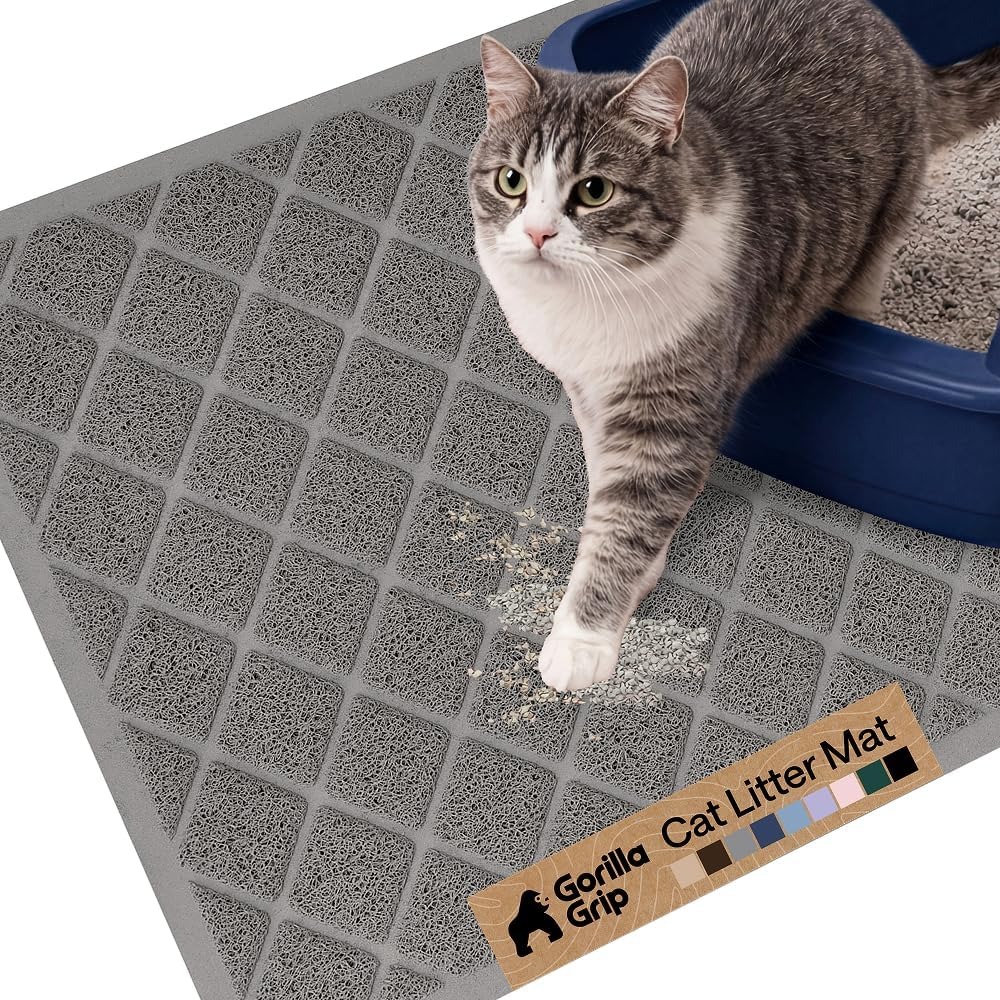
Traps 95% of scattered litter instantly. Waterproof and incredibly easy to clean.
Buy on Amazon →🔗 Affiliate link — you pay the same Amazon price, we earn a small commission at no cost to you.
The Science of Tracking: Why Does Cat Litter End Up Everywhere?
To effectively stop litter tracking, we must first understand the complex biological and physical mechanisms behind it. The phenomenon is an unfortunate perfect storm of feline paw anatomy, ingrained behavioral instincts, and material physics.
The Biological Engineering of the Feline Paw
A cat's paws are marvels of evolutionary engineering, perfectly designed for stealthy hunting, agile climbing, and absorbing the heavy shock of high vertical leaps. The structure of the paw pad, heavily padded with soft, spongy tissue and featuring numerous microscopic crevices, provides phenomenal traction. Unfortunately, this very texture creates the absolute perfect environment for small, granular particles to become tightly lodged. Furthermore, many domestic cats—especially luxurious long-haired breeds like Maine Coons, Ragdolls, Siberians, and Persians—have distinctive tufts of fur growing between their toes. These tufts are meant to protect their feet in snowy climates, but in a modern litter box, they act almost like tiny electrostatic brooms, sweeping up dust and small granules as the cat navigates the terrain. When the cat finally exits the box and confidently walks across your hardwood floor, the natural flexing of the paw pads and the spreading of the toes cause these trapped particles to suddenly dislodge and scatter in every direction.
Ancient Instincts: The Physics of Digging and Covering
In the wild, feline ancestors instinctively buried their waste to hide their scent from potential larger predators and rival competitors. Domestic house cats retain this incredibly powerful, hardwired survival instinct. When a cat uses the litter box, they often engage in vigorous, almost frantic digging and scratching to create a deep depression, followed by extended scratching to thoroughly cover the waste. This vigorous, rapid movement aggressively kicks up fine dust and forcefully flings litter particles high into the air and entirely over the sides of a standard box. The more enthusiastic the digger, the more litter immediately ends up outside the box, patiently waiting to be tracked throughout your house.
Electrostatic Charge and the Humidity Factor
The specific physical properties of the litter itself also play a crucial, often overlooked role. Many traditional clay litters, particularly those based on sodium bentonite, generate significant amounts of fine silica dust during transport and use. As the cat digs, the friction naturally creates a slight electrostatic charge on the cat's fur and paw pads, attracting this lightweight dust and smaller granules like a magnet. When the cat later grooms itself or affectionately rubs against your living room furniture, this dust is smoothly transferred. Additionally, ambient humidity heavily influences tracking. If the litter box is not scooped frequently enough, or if it sits in a humid bathroom, the litter can become slightly damp. Moist litter granules adhere much more aggressively to paws and fur than dry litter, significantly increasing the volume of tracked material.
Method 1: Drastically Upgrade Your Litter Box Strategy
The absolute first line of defense against litter tracking is the containment vessel itself. The standard, inexpensive low-sided open pan sold at most pet stores is practically an open invitation for litter to escape. Upgrading to a more strategically designed, specialized box can immediately and drastically reduce the amount of litter that ever makes it onto your floor.
High-Sided "Fortress" Litter Boxes
For cats that are aggressive diggers or those that tend to stand awkwardly near the edge while urinating or burying, a high-sided litter box is an absolute game-changer. These boxes feature protective walls that are typically 8 to 12 inches high, acting as a sheer physical barrier that aggressively deflects flying granules back into the pan where they belong. When shopping for one, prioritize a box with a lowered, easily accessible entry point. This ensures it remains safe and comfortable for older cats suffering from arthritis or tiny kittens, while the remaining three towering sides provide unparalleled containment.
The Ultimate Shield: Top-Entry Litter Boxes
Top-entry litter boxes offer an even more robust and foolproof solution. These clever, fully enclosed boxes feature a spacious hole situated perfectly in the lid through which the cat enters and exits. Because the side walls are completely solid from top to bottom, absolutely zero litter can be kicked out during the burying process. Furthermore, the textured lid itself acts as an ingenious built-in tracking mat. As the cat powerfully jumps out of the hole, they land directly on the grated lid, which forces their paws to splay open slightly, immediately dislodging any trapped granules that then conveniently fall right back through the holes into the clean box below. While highly effective, always monitor your cat's usage, as elderly cats with mobility issues may find the top opening too restrictive.
Method 2: Implement a Scientifically Strategic Litter Mat Setup
Even with the most advanced litter box on the market, some stubborn granules will inevitably make their way out embedded in your cat's paws. This is precisely where a high-quality, scientifically designed litter mat becomes utterly essential. A simple, cheap decorative rug or an old towel simply will not suffice; you need a mat explicitly engineered to actively trap and securely hold rogue particles.
The Unrivaled Power of the Double-Layer Honeycomb Mat
The absolute gold standard in litter containment technology is the double-layer honeycomb mat. Constructed from durable, non-toxic EVA foam, these mats feature an upper layer completely covered in large, deep honeycomb-shaped holes. As your cat walks confidently across the soft mat, the litter physically falls off their splayed paws and drops deep through the holes into the solid, waterproof bottom layer beneath. This brilliant design securely traps the litter out of sight, preventing it from ever being kicked around or tracked further into the house. When it comes time to clean, the process is delightfully simple: you pick up the mat, separate the two layers slightly, and neatly pour the trapped litter straight back into the box or the trash. It is a highly efficient, closed-loop hygienic system.
Dimensions and Trajectory Matter Immensely
A painfully common mistake among cat owners is purchasing a mat that is far too small. For optimal, reliable effectiveness, the mat must forcefully dictate the cat's exit path. It should extend at least 24 to 36 inches outward from the entrance of the litter box. This considerable distance ensures that the cat absolutely must take several full steps entirely on the mat before their paws ever touch your clean floor, maximizing the mechanical opportunity for trapped granules to be physically dislodged. If your box sits in a corner, strictly ensure the mat securely covers the entire possible path of egress.
Method 3: Evaluate and Transition to Low-Tracking Litter Materials
Not all cat litters are created fundamentally equal when it comes to the physics of tracking. The granular size, absolute weight, and molecular material of the litter directly dictate how easily they stick to paws and fur.
The Nightmare of Lightweight Clumping Clay
Traditional clumping clay litters, and particularly the heavily marketed "lightweight" varieties, are historically notorious for extreme tracking. Their incredibly small, excessively dusty, and suspiciously low-density particles easily become statically charged and tightly wedge into microscopic paw crevices. While they do offer undeniably excellent, rock-hard clumping ability, they are unconditionally the biggest offenders when it comes to maintaining a clean home environment.
The Heavyweight Champions: Pellets and Crystals
To significantly and permanently reduce tracking, you must consider transitioning your feline to a heavier or significantly larger-granule litter. These low-tracking options dramatically out-perform standard clay:
- Pine Pellets: Highly absorbent, completely dust-free, and leaves a pleasant natural wood scent that combats odors effectively.
- Recycled Paper Pellets: Extremely soft on sensitive paws, highly sustainable, and their large size makes tracking nearly impossible.
- Tofu Litter: A modern, biodegradable marvel that clumps well but is formulated in larger, extruded strands that simply do not stick to fur.
- Silica Crystals: Excellent for severe odor control, and while individual pieces can roll, they absolutely never create the powdery, smearing mess of clay.
Method 4: Maintain Impeccable, Odor-Free Box Hygiene
A scrupulously clean litter box is exponentially less likely to cause a tracking nightmare. When a box is visibly overflowing with organic waste and saturated, heavy clumps, the remaining dry litter rapidly becomes contaminated, and the cat is physically forced to step on heavily soiled areas to navigate. Damp, soiled litter clumps stick to paws infinitely more aggressively than fresh, dry granules, creating a disgusting and highly mobile mess.
The Absolute Necessity of Daily Scooping
You must commit to scooping the litter box at least once, and ideally twice, every single day. Removing heavy clumps and solid waste promptly ensures that your cat always has a pristine, completely dry surface to step on. This not only directly prevents damp litter from sticking to their sensitive paws but also strongly encourages perfect litter box habits and prevents pungent odors from permanently permeating your home's fabrics.
Streamlining Your Routine with Proper Tools
To make this essential daily scooping a frictionless breeze rather than a dreaded chore, it is absolutely essential to have the correct tools staged perfectly on hand. Keeping a dedicated, specialized disposal system literally right next to the box prevents accidental spills and dropped, crumbling clumps during clean-up. We highly, unconditionally recommend utilizing the Litter Genie disposal system for this exact purpose. The benefits are clear:
- Complete Odor Isolation: The patented multi-layer film physically locks away the foulest smells, keeping your home fresh.
- Zero Carrying Risk: It entirely eliminates the treacherous walk across the house with a fragile, crumbling scoop of waste, which is a massive source of tracking.
- Time Efficiency: It reduces the grueling daily trip to the outside trash can down to a simple once-a-week bag replacement task.
🧹 Our Top Pick: Gorilla Grip Honeycomb Litter Mat
Traps 95% of scattered litter instantly. Waterproof and incredibly easy to clean.
Buy on Amazon →🔗 Affiliate link — you pay the same Amazon price, we earn a small commission at no cost to you.
Method 5: Optimize Box Location Based on Feline Psychology
Where you physically place the litter box within your home has a surprising, dramatic impact on exactly how far escaping litter is tracked. Strategic, thoughtful placement can naturally, organically limit the spread of rogue granules.
Ban the Box from High-Traffic Zones
Placing a litter box in a busy, central hallway, the family kitchen, or a heavily used living room essentially guarantees that any escaped litter will be immediately stepped on by human shoes and aggressively dispersed throughout the entire house. You must keep the box in a dedicated, distinctly low-traffic area such as an isolated laundry room, a quiet utility closet, or a rarely used guest bathroom.
Constructing a Dedicated "Runway"
If architecturally possible, aggressively position the litter box so that the cat is physically forced to walk down a defined, narrow path to exit the area. For example, placing the box at the absolute far end of a narrow laundry room forces the cat to walk across a much longer stretch of specialized matting or hard, easily swept floor before ever reaching precious carpeted areas. This extended, mandatory runway gives significantly more time for trapped litter to fall off naturally. You can enthusiastically enhance this by lining the runway with a continuous, heavy-duty runner rug explicitly designed to trap deep dirt and debris.
Method 6: Actively Manage Paw Fur and Coat Grooming
As previously established, the tufted fur between a cat's toes acts as an incredibly efficient magnet for dust and litter. If you are blessed with a stunning long-haired breed, actively managing this specific fur is a highly effective, direct way to immediately reduce tracking.
Precision Trimming of Toe Tufts
Using high-quality, blunt-nosed grooming scissors or a specialized, ultra-quiet electric pet trimmer, carefully and meticulously trim the excess hair protruding from between your cat's paw pads. Ensure the fur is relatively flush with the rubbery pads. This directly removes the problematic "broom" effect, making it mechanically much harder for litter to cling. Always be sure to handle your cat's sensitive paws gently and generously offer high-value treats to make the experience overwhelmingly positive. If you are mildly uncomfortable performing this delicate task yourself, an experienced professional groomer or your trusted veterinarian can easily and safely perform this quick procedure.
The Power of Routine Brushing
Frequent, thorough brushing with an undercoat rake or slicker brush massively helps reduce the static charge in your cat's luxurious coat and actively removes loose fur that might otherwise heavily trap dust while they are inside the litter box. A brilliantly healthy, well-groomed coat is simply significantly less likely to act as a massive static cling surface for lightweight, airborne litter particles.
Method 7: Scientifically Control the Depth of the Litter
An astonishing number of well-meaning cat owners make the grave mistake of vastly overfilling the litter box, incorrectly assuming that more litter is inherently better. However, a box that is optimistically filled to the absolute brim is practically mathematically guaranteed to result in massive spillage and disastrous tracking.
Discovering the "Goldilocks" Depth
The depth of your litter creates drastically different outcomes depending on how much you pour in:
- 1 Inch or Less: Far too shallow; liquid urine will rapidly pool and tightly cement itself to the bottom plastic of the box, creating a smelly nightmare to scrape and clean.
- 2 to 3 Inches: The absolute scientific sweet spot; this specific depth provides perfect moisture absorption and fully satisfies deep digging instincts without causing any unnecessary excess spillage over the sides.
- 4 Inches or More: Vastly too deep; creates massive, immediate tracking as the cat awkwardly wades through the heavy dunes and easily kicks the high-piled granules straight over the protective sides.
Maintaining Absolute Consistency
As you dutifully scoop daily, the overall litter level will naturally and steadily decrease. You must top it up gradually and carefully to flawlessly maintain that optimal, pristine 2 to 3-inch depth. Resolutely avoid the common temptation to dump an entire new 20-pound bag in all at once simply to empty the bag, as this will instantly lead to a massively overfilled box and immediate, severe tracking issues the very next time your cat visits the box.
Method 8: Deploy Secondary Environmental Barriers
If you have diligently implemented every single one of the previous seven methods and are still inexplicably struggling with minor, annoying tracking, it is finally time to employ strategic secondary barriers to effortlessly catch the stubborn stragglers.
Engineering Effective Transition Zones
Creatively engineer a distinct physical transition zone between the specific room housing the litter box and the rest of your clean home. For prime example, if the box resides safely in a guest bathroom, firmly place a highly absorbent, heavily textured bath mat or an additional, smaller honeycomb mat just inside the bathroom door threshold. This intelligently serves as a final, secondary trap for any microscopic particles that miraculously made it past the primary mat system. Vacuum or aggressively shake out these transition mats very frequently.
The Magic of Frequent, Targeted Vacuuming
Finally, permanently keeping a powerful handheld vacuum or a convenient, lightweight cordless stick vacuum securely plugged in and mounted directly near the litter area allows for immediate, low-effort spot cleaning. Spending a mere 30 seconds a day aggressively vacuuming the immediate 5-foot radius entirely around the litter box decisively prevents those few stray granules from ever migrating into the rest of your pristine home. Alternatively, deploying a smart robot vacuum explicitly programmed to thoroughly clean the specific litter box room daily can be an absolute, life-changing time-saver and a fundamentally crucial, high-tech component of your comprehensive, unbeatable anti-tracking strategy.
The Ultimate Conclusion: A Multi-Faceted Strategy for a Pristine Home
Stopping litter tracking absolutely and completely, down to the final microscopic grain, is perhaps an elusive, impossible goal—cats are, after all, living animals, and a minuscule, unavoidable degree of mess is a natural, accepted part of sharing a wonderful life with them. However, by strictly implementing this sophisticated, multi-faceted approach, you can easily and reliably reduce tracking by an astonishing 95% or more. By deeply understanding the exact physical mechanics of how litter sticks to paws and utilizing precisely the right cutting-edge equipment—such as fortress-like high-sided boxes, miraculous honeycomb mats, heavy low-tracking litter, and incredibly efficient, odor-locking disposal systems—you can finally reclaim your brilliantly clean floors and completely enjoy a far more hygienic, stress-free environment for both you and your beloved feline companion. Always remember that strict consistency is the ultimate key: maintain a rigorous, unyielding cleaning schedule, closely monitor your cat's unique habits, and enthusiastically make minor adjustments as needed to discover the perfect, flawless combination of permanent solutions for your specific household.
🧹 Our Top Pick: Gorilla Grip Honeycomb Litter Mat
Traps 95% of scattered litter instantly. Waterproof and incredibly easy to clean.
Buy on Amazon →🔗 Affiliate link — you pay the same Amazon price, we earn a small commission at no cost to you.